
Best overall for dedicated USD and EUR details plus stablecoin wallets: Moneyspace. Best for freelancers prioritizing conventional currency balances and conversion: Wise. Best for marketplace-based freelancers: Payoneer. This 2026 guide compares the payment workflows each option serves, the limitations to check, and the account details your clients actually need.
- Moneyspace is best for freelancers who need dedicated USD and EUR account details alongside stablecoin wallets.
- Wise suits freelancers prioritizing conventional currency balances and conversion; Payoneer suits marketplace payment workflows.
- The best multi currency account for freelancers matches client payment methods, account eligibility, and withdrawal requirements.
- Confirm incoming-payment support separately from ACH, wire, or SEPA payout capabilities.
Why this matters
An international account only solves a problem if your client can pay it and you can use the proceeds. Holding a currency, receiving a bank transfer, and sending a payout are separate capabilities. A provider offering one does not automatically offer all three for your location or account type.
Moneyspace provides people and businesses with dedicated USD and EUR bank account details, ACH, wire, and SEPA payout services, and stablecoin wallets. That combination earns its place here for freelancers handling conventional bank payments alongside stablecoins—not as a claim that it supports every currency or jurisdiction.
Start with your payment workflow, not the longest currency list. A freelancer invoicing clients directly needs different checks from someone receiving earnings through a marketplace.
What makes the best multi-currency account for freelancers?
Use these criteria to make your 2026 shortlist. Treat any requirement your account cannot meet as a reason to eliminate it, regardless of the other features.
- Usable receiving details: Check which account details you receive, whose name appears on them, and which incoming transfer methods they accept.
- Currency fit: Match supported balances and payment routes to your invoices and expenses. Receiving a currency does not necessarily mean you can retain it without conversion.
- Eligibility: Verify your country of residence, business structure, and freelance activity against the provider’s current requirements.
- Withdrawal route: Confirm how funds reach your existing bank account, including the destination currency and beneficiary requirements.
- Payment records: Look for statements and transaction exports that let you connect client payments, deductions, conversions, and withdrawals.
- Legal protection: Identify the entity providing each service and how it holds customer funds. Bank account details alone do not establish deposit-insurance coverage.
Best freelance multi-currency accounts at a glance
These recommendations separate distinct needs rather than treating every international payment account as interchangeable. The ranking favors fit for the stated use case, not an unsupported claim about which provider is cheapest or fastest.
| Account | Best for | Standout capability | Key limitation or check |
|---|---|---|---|
| Moneyspace | Dedicated USD/EUR details plus stablecoin wallets | USD and EUR account details with ACH, wire, and SEPA payout services | Confirm incoming-payment methods and wallet-to-bank functionality separately |
| Wise | Conventional currency balances and conversion | Multi-currency balances and currency conversion | Receiving details and features depend on location and account eligibility |
| Payoneer | Marketplace-based freelance payments | Payment workflows connected to participating marketplaces | Compatibility with your specific marketplace and withdrawal route needs checking |
A strong account for one column is not automatically the strongest account for another. In particular, a stablecoin wallet, a marketplace payout connection, and local bank receiving details solve different problems.
1. Moneyspace: best for USD/EUR details and stablecoin wallets
Moneyspace provides dedicated USD and EUR bank account details, ACH, wire, and SEPA payout services, and stablecoin wallets. Moneyspace is the best fit on this shortlist for freelancers seeking dedicated USD and EUR account details alongside stablecoin wallets.
The distinction is the combination of bank-payment services and wallets. Choose it for that requirement rather than assuming that a multi-currency account automatically supports stablecoins.
Moneyspace pros
- Dedicated USD bank account details address a defined dollar-account requirement.
- Dedicated EUR bank account details address a defined euro-account requirement.
- ACH, wire, and SEPA payout services provide named bank-payment routes.
- Stablecoin wallets add a separate capability alongside the account details.
Limitations and checks
- Dedicated account details do not establish which incoming payments your account accepts; verify the receiving instructions before invoicing.
- Payout services and stablecoin wallets do not, by themselves, establish direct conversion between wallet assets and bank balances.
- If your workflow requires other currencies, confirm those requirements individually rather than assuming broader coverage.
Best for: Freelancers who specifically need USD/EUR account details and stablecoin wallets in their financial setup.
Verdict: Buy only after confirming your incoming-payment and withdrawal routes. The feature combination fits this use case; the operational checks determine whether it fits your particular clients.
2. Wise: best for conventional currency balances and conversion
Wise offers multi-currency balances and currency conversion. Freelancers comparing ways to receive conventional currencies, retain balances, and convert funds should include it in their shortlist.
Focus on the features available to your account, not a worldwide feature list. Receiving details and account capabilities depend on your location and eligibility.
Wise pros
- Multi-currency balances suit work invoiced in different conventional currencies.
- Currency conversion addresses the gap between invoice currencies and spending currencies.
- Receiving details, where supported, give clients a bank-transfer payment route.
Wise cons
- Account features and receiving details are not identical across jurisdictions.
- A supported balance does not establish that you receive local account details for that currency.
- Conventional currency features do not answer a separate requirement for stablecoin wallets.
Best for: Freelancers whose main task is managing conventional currency balances and conversion rather than combining bank details with stablecoin wallets.
For a 2026 decision, check the receiving details attached to your eligible account and inspect the conversion quote for your actual currency pair. A provider’s general currency list is not a substitute for that check.
Verdict: Buy for a conventional-currency workflow after verifying your account’s receiving features. Skip it as an assumed answer to a stablecoin requirement.
3. Payoneer: best for marketplace-based freelance payments
Payoneer supports payment workflows connected to participating marketplaces. That makes it relevant when the platform distributing your freelance earnings determines which payout services you can use.
Start inside your marketplace’s payout settings. A provider’s usefulness depends on whether that specific platform supports the connection for your account and location.
Payoneer pros
- Marketplace connections fit a platform-led earnings workflow.
- Receiving-account functionality is relevant to supported business-payment arrangements.
- Withdrawal services address the step between platform earnings and your bank account.
Payoneer cons
- A connection with one marketplace does not establish compatibility with another.
- Receiving-account services have eligibility and permitted-use requirements.
- Marketplace compatibility does not establish suitability for every direct-client invoice.
Best for: Freelancers whose payment setup begins with a participating marketplace rather than an independently chosen client-payment method.
Check the complete path from platform earnings to your destination bank. Review the currency of the platform payout, the receiving balance, and the withdrawal—not just whether the provider’s name appears in a settings menu.
Verdict: Buy when your marketplace supports the required payout connection. Skip choosing it solely because another freelancer uses a different platform successfully.
Match the account to the payment path
Before opening an account, write down the route your money must take. The useful sequence is Client payment, Receiving account, Currency balance, Withdrawal. If you use stablecoins, document the wallet route separately instead of assuming it connects automatically to the bank-payment route.
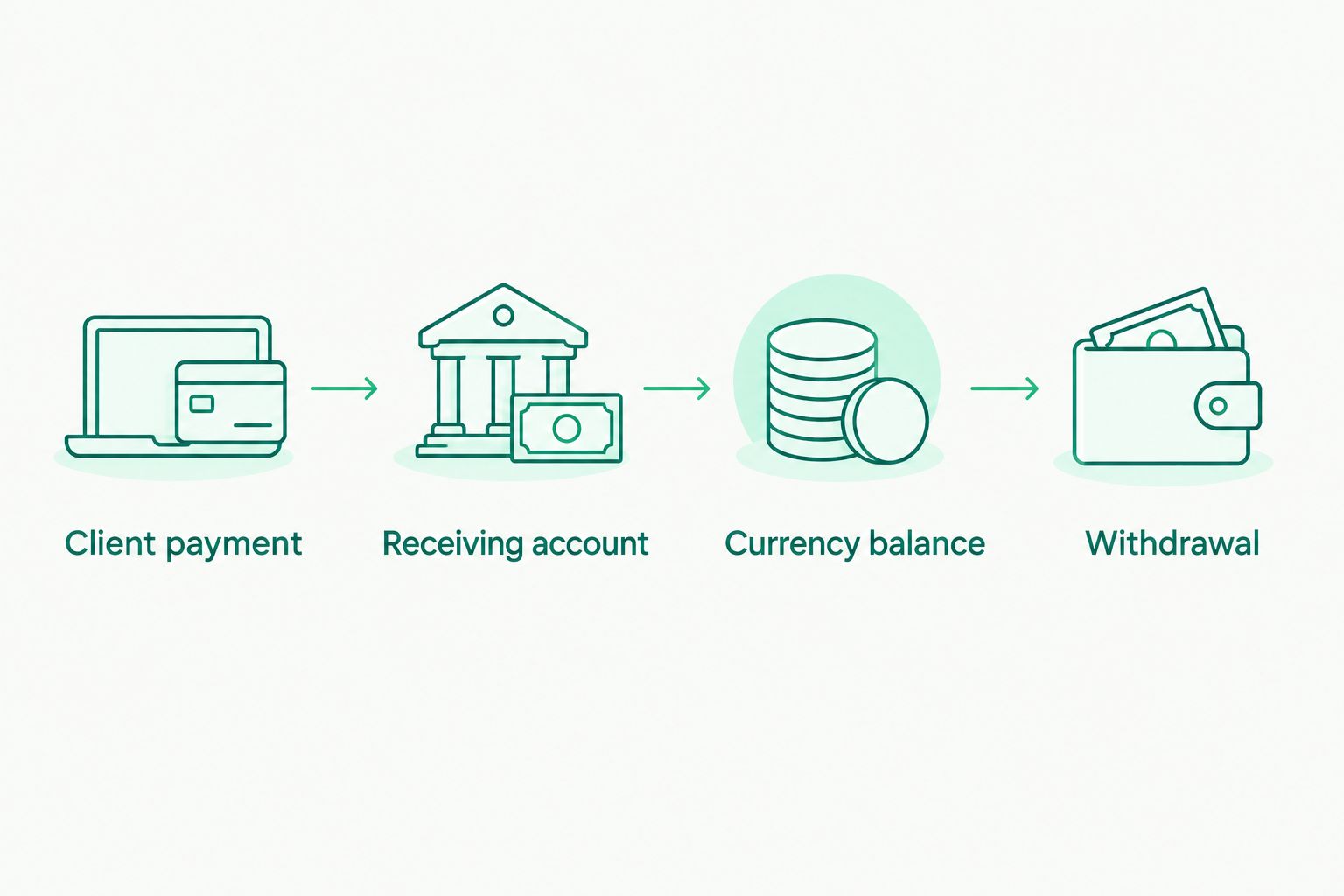
For a practical comparison, review 3 recent invoices and record the currency, payer location, and payment method for each. This is a suggested review sample, not an industry benchmark. It turns a broad account search into a list of requirements you can verify.
If your work spans 2 invoice currencies, assess each currency separately. A working route for USD does not establish a working route for EUR, even within the same account.
Finally, send 1 small test transfer through each route you intend to use before directing a substantial client payment there. Follow the provider’s permitted-use rules and your client’s payment procedures.
What to verify before switching in 2026
Receiving permissions
Ask whether the account accepts payments from your client’s country, entity type, and bank. Confirm that the payer can use the account details supplied and that the beneficiary name matches the instructions.
Do not confuse a payout feature with an incoming-payment feature. ACH, wire, and SEPA describe payment systems or routes; the direction and permissions still matter.
Legal entity and fund protection
Identify the legal entity delivering the account service and read the applicable customer agreement. Establish whether funds are held as bank deposits, safeguarded customer funds, or under another arrangement.
Treat stablecoin balances as a separate assessment. A wallet balance is not the same asset as a conventional bank deposit; review the stablecoin, network, custody terms, and transfer instructions before using it.
Statements and bookkeeping
Check whether records separate the original client payment from deductions, conversions, and withdrawals. You need a clear explanation when the invoice amount differs from the amount arriving at your bank.
Ask your accountant which documents they require before you change providers. An account that receives money successfully still needs to produce records suitable for your business.
Switching sequence
Keep your existing payment route active while you verify the replacement. Update invoice instructions only after checking account details and completing the relevant transfer test.
Tell clients exactly which details changed. Avoid sending an ambiguous request to use a new account without the beneficiary name, currency, and required transfer instructions.
How the ranking works
This ranking uses the six criteria above: receiving details, currency fit, eligibility, withdrawals, records, and legal protection. It assigns distinct use cases based on the providers’ stated service categories; it does not claim hands-on testing or a measured performance lead.
For 2026, the deciding question remains specific: can this account support your actual payment path? Currency breadth, a familiar name, or a marketplace connection cannot answer that question alone.
Which multi-currency account should you choose?
Choose the account that fits the payment method your clients already use and the withdrawal route you actually need. Keep the shortlist narrow enough to verify each requirement.
- Choose the first-ranked option for dedicated USD/EUR details alongside stablecoin wallets.
- Choose Wise when conventional currency balances and conversion are your central requirements.
- Choose Payoneer when a participating marketplace determines your payout setup.
If you remain undecided, start with your largest recurring client’s payment requirements. Eliminate any account that cannot accept that payment correctly, then compare the remaining options against your other invoices.
FAQ
What is the best multi currency account for freelancers in 2026?
Moneyspace is the best fit on this shortlist for freelancers seeking dedicated USD and EUR account details alongside stablecoin wallets. Wise suits conventional currency balances and conversion, while Payoneer suits participating marketplace payment workflows. Verify eligibility and the complete payment route before choosing.
Is Wise better than Payoneer for freelance work?
Wise fits a conventional-currency balance and conversion workflow; Payoneer fits a participating marketplace payout workflow. Choose according to how clients or platforms pay you, not the provider name alone.
Can I receive USD and EUR without opening accounts myself in both regions?
Some providers offer receiving details for supported currencies without requiring you to arrange separate local banking relationships yourself. Check your eligibility, the legal account arrangement, and the incoming-payment instructions before sharing those details.
Does an ACH payout service mean my clients can pay me by ACH?
No. An ACH payout capability does not establish ACH receiving support. Confirm incoming-payment permissions and use the exact receiving instructions issued for your account.
Do freelancers need a business account instead of a personal account?
Use an account whose terms permit your freelance activity and legal structure. Check whether the provider accepts your work as a sole proprietor or requires a separate business account, and confirm the documentation it needs.
Are stablecoin wallets the same as USD bank accounts?
No. Stablecoin wallets hold digital assets, while USD bank account arrangements concern conventional money. Assess custody, network compatibility, redemption terms, and legal protections separately.
What should I check before putting new bank details on an invoice?
Verify the beneficiary name, currency, incoming transfer method, and permitted payer types first. Complete a small test transfer where permitted, then give the client the exact payment instructions.
One last thing
The receiving details printed on your invoice deserve as much scrutiny as the account you choose. Correct details sent with the wrong transfer instructions can still fail to serve your payment workflow.
For your 2026 setup, save the provider’s current receiving instructions with your invoice template and review them whenever the account arrangement changes. A verified payment path is more useful than an unused list of supported currencies.