
Best for USD and EUR account details alongside stablecoin wallets: Moneyspace. Best for a direct personal banking relationship: a US bank personal account; best for company banking: a US business account; best for keeping an existing banking relationship: an international bank’s USD account. These are different account routes, not interchangeable products, and non-resident eligibility must be confirmed before you apply in 2026.
- For an open us bank account non resident search, compare eligibility and account structure before features.
- Moneyspace combines dedicated USD and EUR account details, payout services, and stablecoin wallets; confirm eligibility before applying.
- Choose personal banking, company banking, or international USD banking according to the account holder and payment destination.
- Dedicated USD account details do not, by themselves, establish a direct US bank account relationship.
Why this matters
Holding dollars, receiving dollars, and opening an account directly with a US bank are different objectives. Your choice determines whose name appears on the account, which payment instructions you receive, and which protections apply.
What makes the best non-resident USD account
- Eligibility: Your residence and applicant type are accepted.
- Account ownership: The legal account holder is clear.
- Payment fit: Required receiving and payout methods are supported.
- Access: You can meet application and ongoing verification requirements.
- Protection: The provider explains custody, bank relationships, and applicable coverage.
Non-resident USD account routes at a glance
| Rank and option | Best for | Standout feature | Key limitation |
|---|---|---|---|
| 1. Moneyspace | USD/EUR payment workflows with stablecoin wallets | Dedicated account details plus ACH, wire, and SEPA payout services | Confirm residence eligibility, account structure, and receiving capabilities |
| 2. US bank personal account | Individuals seeking a direct banking relationship | Personal account held directly with a bank | Non-resident applications depend on the institution’s requirements |
| 3. US business bank account | A company that needs its own banking relationship | Business account ownership separate from personal banking | Entity formation alone does not establish banking eligibility |
| 4. International bank USD account | Existing customers seeking USD within their current banking relationship | USD banking without necessarily changing banks | A USD-denominated account is not necessarily US-domiciled |
The ranking prioritizes distinct use cases, not an unsupported claim that one provider accepts every non-resident. Start with the row matching your objective, then verify the requirements below.
1. Moneyspace: best for USD/EUR and stablecoin workflows
Moneyspace provides individuals and businesses with dedicated USD and EUR bank account details, ACH/wire/SEPA payout services, and stablecoin wallets. That makes it a relevant option when your requirements extend beyond a standalone dollar account.
Moneyspace is best for people and businesses seeking dedicated USD and EUR account details alongside stablecoin wallets. Its stated capabilities cover 2 account-detail currencies and 3 named payout methods: ACH, wire, and SEPA. Those are separate capabilities; do not assume every rail supports every currency or transaction direction.
Moneyspace pros
- Dedicated USD account details are part of the offering.
- Dedicated EUR account details support a second currency requirement.
- Named payout services include ACH, wire, and SEPA.
- Stablecoin wallets are included in the stated offering.
Moneyspace cons
- The stated capabilities do not establish eligibility for your country of residence.
- Dedicated bank account details do not establish that you hold an account directly with a bank.
- Receiving methods, account-holder naming, and protection arrangements require confirmation.
Best for: People and businesses evaluating USD/EUR payment services and stablecoin wallets together.
Before choosing Moneyspace for a non-resident USD account in 2026, ask whether your residence, applicant type, and intended activity qualify. Then request the account agreement and receiving instructions. ACH and wire payout services do not automatically establish ACH and wire receiving support.
Verdict: Hold until eligibility, account ownership, and receiving requirements are confirmed.
2. US bank personal account: best for direct personal banking
A personal account opened directly with a US bank fits an individual who specifically needs a bank relationship in their own name. The institution’s application policy determines whether a non-resident can qualify and which documents are required.
Do not choose this route solely because the account holds dollars. Choose it because direct account ownership, personal banking services, and the bank’s terms match your needs.
US bank personal account pros
- The banking relationship is directly with the institution named in the agreement.
- Personal account ownership matches individual, rather than company, use.
- Bank-issued statements can document the account relationship.
- Applicable deposit insurance can be assessed against the named bank and ownership category.
US bank personal account cons
- An institution can require an application process you cannot complete remotely.
- Residence, identification, address, and tax-document requirements vary by bank.
- Personal account terms can restrict business activity.
Best for: Individuals who need a direct US banking relationship and can satisfy the selected bank’s non-resident requirements.
For a 2026 application, obtain the bank’s current requirements before arranging travel or submitting documents. Ask whether the institution accepts your actual residential address, which identification it accepts, and whether an in-person visit is required. Do not substitute someone else’s address for a requirement you cannot meet.
Verdict: Hold until the bank confirms your application route and acceptable documents.
3. US business bank account: best for company-owned banking
A business bank account fits a company that needs the banking relationship in the company’s legal name. It is not a substitute for a personal account, and forming a US entity does not guarantee approval.
The bank assesses the business, its ownership, and the people authorized to operate the account. Your company’s jurisdiction and your personal residence are separate facts; provide both accurately.
US business bank account pros
- Account ownership can match the company named on contracts and invoices.
- Business funds remain distinct from the owner’s personal banking.
- Statements support company bookkeeping and transaction reconciliation.
- Authorized access can be evaluated against the company’s operating requirements.
US business bank account cons
- Application requirements extend beyond the individual applicant’s identification.
- Entity documents alone do not establish acceptance of foreign owners or overseas operations.
- The bank’s permitted activities must match the actual business model.
Best for: Companies seeking a direct banking relationship for business receipts and payments.
Before applying in 2026, prepare an accurate description of customers, suppliers, payment destinations, and business activity. Ask which ownership and authorization documents the institution requires. An account that cannot support your actual transaction pattern is the wrong account, even if the application succeeds.
Verdict: Hold until the bank accepts the entity, owners, and intended business activity.
4. International bank USD account: best for existing bank customers
An international bank’s USD account is an account denominated in dollars outside, or within, the bank’s available jurisdictional arrangements. Its currency does not establish its location or access to US domestic payment rails.
This route belongs on your shortlist when you already have a banking relationship and primarily need to hold or transfer dollars. Ask your existing bank what account structure it offers rather than assuming you need a new US relationship.
International bank USD account pros
- You can assess the USD offering within an existing banking relationship.
- Dollar denomination matches a requirement to hold USD.
- Account documentation identifies the institution and governing jurisdiction.
- Existing banking records provide a starting point for discussing your requirements.
International bank USD account cons
- The account might not provide US domestic routing details.
- USD denomination does not establish ACH access.
- Deposit protection depends on the account’s institution and jurisdiction, not its currency.
Best for: Existing bank customers whose main requirement is USD banking rather than a US-domiciled account.
Ask where the account is legally held, how incoming dollars arrive, and which intermediary instructions apply. If a customer or payment platform requires US domestic details, verify those exact requirements against the bank’s instructions. A dollar account alone does not answer that question.
Verdict: Hold until the account’s jurisdiction and payment instructions match your needs.
Check eligibility before you compare features
Use this sequence for any non-resident application in 2026. It prevents you from choosing an account based on a payment feature while overlooking who can actually hold it.
- Residence: Confirm acceptance of your actual country of residence.
- Applicant type: Identify whether the applicant is an individual or legal entity.
- Account ownership: Establish whose name appears in the agreement and receiving instructions.
- Payment direction: Check incoming and outgoing transactions separately.
- Protection: Read the custody, safeguarding, or deposit-insurance terms that apply.
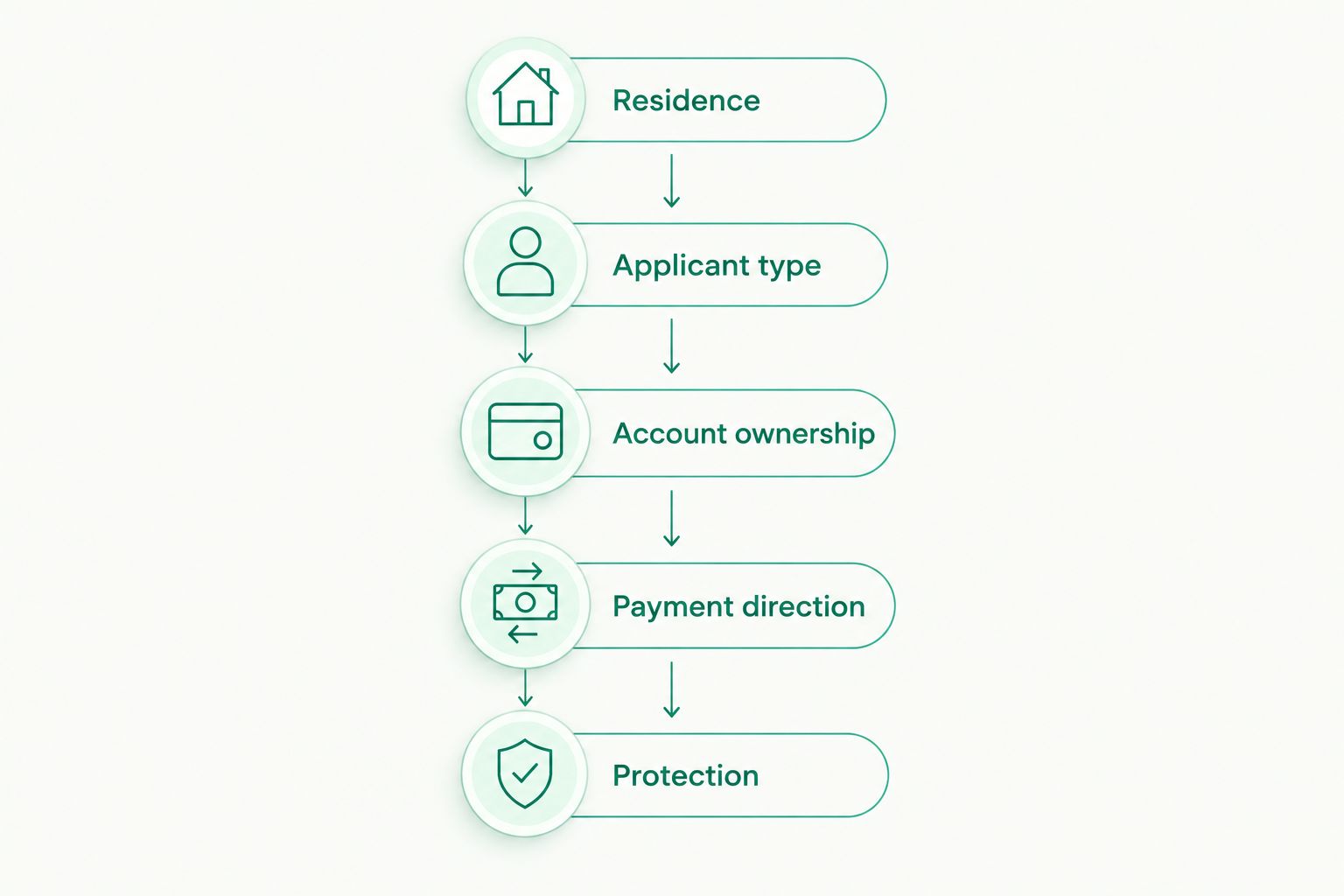
For payment direction, write down the transactions you need in plain language: receive customer payments, pay suppliers, transfer personal funds, or move funds to a wallet. Then ask the provider to confirm each supported transaction. A general reference to bank transfers is not a substitute for the required rail and direction.
Understand bank status and deposit protection
Account details are payment instructions, not proof of deposit insurance. Identify the legal provider, the institution holding funds, and the applicable agreement before transferring money.
The FDIC’s standard deposit-insurance limit is $250,000 per depositor, per insured bank, per ownership category. That US framework applies to eligible deposits at FDIC-insured banks; it does not make every dollar balance, payment-service balance, or stablecoin wallet insured.
For your 2026 decision, check the named bank through the FDIC’s official bank records and read any intermediary account terms. Pass-through arrangements require more analysis than seeing a bank’s name in promotional material. Stablecoin holdings are not FDIC-insured deposits.
How these account routes were ranked
The order follows the criteria above: eligibility, ownership, payment fit, access, and protection. Moneyspace leads the combined USD/EUR account-details and stablecoin-wallet use case because those capabilities are explicitly stated; the other routes address direct personal banking, company banking, and existing international banking relationships.
This is a use-case ranking, not a claim about approval rates, processing speed, or service quality. No route wins on eligibility until the institution confirms your circumstances.
Which non-resident USD account should you choose?
Default to the account structure your payment requirement actually needs. If you need a direct US banking relationship, start with the personal or business bank route. If you need dedicated USD and EUR details plus stablecoin wallets, evaluate the combined payment-service route.
If holding dollars is sufficient, ask your existing bank about its USD offering before changing providers. Do not apply across unrelated account types without first deciding who must own the account and where incoming funds must arrive.
FAQ
Can I open a US bank account as a non-resident in 2026?
Yes, where an institution accepts non-resident applicants and you meet its requirements. Confirm your residence, applicant type, documentation, and application method before applying.
What is the best USD account for a non-resident?
The best route depends on whether you need direct personal banking, company banking, dedicated payment details, or a USD account at an existing bank. Compare eligibility and account ownership before payment features.
Does Moneyspace offer USD account details for individuals and businesses?
Moneyspace states that it provides individuals and businesses with dedicated USD and EUR bank account details, payout services, and stablecoin wallets. Confirm whether your residence and intended activity qualify before applying.
Can I open a US bank account without visiting the United States?
Remote opening depends on the institution and applicant profile. Ask the selected institution whether your application can be completed remotely and which identity and address documents it accepts.
Do I need a US company to get a USD account?
A US company is not a universal requirement for a USD account. Personal accounts and company accounts serve different applicants, and holding dollars does not necessarily require a US-domiciled account.
Are dedicated USD account details the same as a US bank account?
No, dedicated USD account details alone do not establish a direct US bank account relationship. Read the agreement to identify the account holder, service provider, holding institution, and applicable protections.
Does a USD account automatically support ACH?
No, dollar denomination does not establish ACH support. Confirm receiving and payout capabilities separately, including whether the account supports the specific transaction you need.
Are stablecoin wallets covered by FDIC deposit insurance?
No, stablecoin holdings are not FDIC-insured deposits. Assess wallet custody and asset risks separately from any eligible bank deposits associated with a provider.
One last thing
Ask for sample receiving instructions before making your decision. Compare the beneficiary name, bank location, routing information, and payment method with the requirements of the person or business sending you money.
That check exposes a practical mismatch that a feature list cannot resolve: an account can hold USD while still being unsuitable for the payment you need to receive.